
The most common answer to this question is also the least useful one: “it depends.” That’s technically accurate, but it doesn’t help you figure out how to budget for one of the most significant legal expenses most people will ever face. A more useful answer requires understanding what actually drives divorce attorney costs — because the factors that make a divorce expensive are largely predictable, and knowing them early enough gives you some ability to influence the outcome.
Key Takeaways
- The total cost of a divorce attorney depends on whether the divorce is contested or uncontested, the hourly rate in your geographic market, and how many issues (property, custody, support) require litigation rather than negotiation
- Uncontested divorces with attorneys typically run $1,500–$5,000 total; contested divorces with significant disputes routinely cost $15,000–$50,000+ depending on complexity and how long the litigation runs
- Divorce attorneys cannot take cases on contingency — they charge hourly rates or flat fees paid by the client upfront, which is a fundamental difference from personal injury or employment law
Why Contingency Isn’t an Option in Divorce
Before getting into numbers, one point that surprises many people: you cannot hire a divorce lawyer on contingency. Contingency fees — where the attorney takes a percentage of the recovery only if they win — are prohibited in domestic relations matters under the American Bar Association’s Model Rules of Professional Conduct. The ethical prohibition exists because contingency fees in divorce would create a financial incentive for attorneys to push for higher alimony or property awards rather than acting in the client’s best interest.
What this means practically: you pay for divorce legal services as they happen, either through hourly billing drawn from a retainer or through a flat fee agreed upon upfront. The money comes out of your pocket during the process, not from the outcome.
The Fee Structures You’ll Encounter
Hourly Rate With Retainer
The most common structure for contested divorces. You pay a retainer — a deposit that goes into a trust account — and the attorney bills against it at their hourly rate. When the retainer is depleted, you replenish it. The final total depends on how many hours the case actually requires.
What drives hourly rates:
Geographic market is the largest variable. Divorce attorneys in major metro areas (New York, Los Angeles, Chicago, San Francisco) charge $300–$600+ per hour. Mid-size city attorneys typically charge $200–$350 per hour. Rural and smaller market attorneys often charge $150–$250 per hour. These are general ranges — individual attorneys vary significantly within each market based on experience and specialization.
Experience level matters significantly. A first-year family law associate may charge $175/hour; a senior partner who handles complex high-asset divorces may charge $600+/hour. The more experienced attorney may actually cost less in total if they work more efficiently and make fewer errors that require correction.
Initial retainers typically run $2,500–$10,000 for straightforward contested divorces and $10,000–$25,000+ for complex cases involving significant assets, business valuations, or contentious custody disputes. The retainer is not the total cost — it’s the starting deposit.
Flat Fee
Common for uncontested divorces where both parties have already agreed on all terms. The attorney prepares the paperwork, files the petition, and handles the process for a fixed amount. Flat fees for uncontested divorces typically run $1,500–$3,500, though this varies by market. Court filing fees (typically $100–$400 depending on the state) are usually additional.
The flat fee structure only works when the scope is predictable. If an uncontested divorce becomes contested — because the parties can’t finalize an agreement or one party changes their position — the flat fee arrangement typically converts to hourly billing.
Limited Scope Representation
Some attorneys offer “unbundled” legal services — handling specific tasks rather than full representation. You might hire an attorney to review a settlement agreement drafted by a mediator, or to coach you for a hearing while you represent yourself overall. This can significantly reduce costs when you can do some of the work yourself, while still getting professional guidance on the pieces that matter most.
What Contested vs. Uncontested Actually Means
This distinction determines your cost range more than any other factor.
Uncontested divorce: Both parties agree on all terms — asset division, debt allocation, spousal support if applicable, and custody and child support if children are involved. The attorney (or attorneys) prepare the paperwork reflecting the agreement and navigate the court process. A single attorney can handle an uncontested divorce for one party; some couples use a mediator to reach agreement and then hire separate reviewing attorneys for each spouse.
Contested divorce: The parties disagree on one or more significant issues. Each contested issue adds cost because it requires attorney time for negotiation, motions practice, discovery, and potentially hearing or trial time. The more issues that are contested, and the more intractable the disagreement, the longer the litigation runs and the higher the total cost.
The issues that most commonly drive up costs:
Child custody is the single most expensive element of most divorces. Custody disputes can involve guardian ad litems, custody evaluators, parenting experts, and multiple hearings. A serious contested custody matter can add $10,000–$30,000 or more to the total cost on each side.
Business valuation requires a forensic accountant or business valuation expert, whose fees are separate from attorney fees and routinely run $5,000–$20,000. High-asset divorces with complex financial portfolios, real estate holdings, or partnership interests require significantly more expert work.
Hidden asset allegations trigger extensive discovery — subpoenas, forensic accounting, depositions — each of which generates billable hours. If one spouse believes the other is concealing assets, the litigation to uncover them can be extensive and expensive.
Spousal support (alimony) disputes require evidence of each party’s income, expenses, earning capacity, and standard of living. The analysis is fact-intensive and attorney-time-intensive.
Realistic Total Cost Ranges
These ranges represent what many clients actually spend, based on the type of divorce:
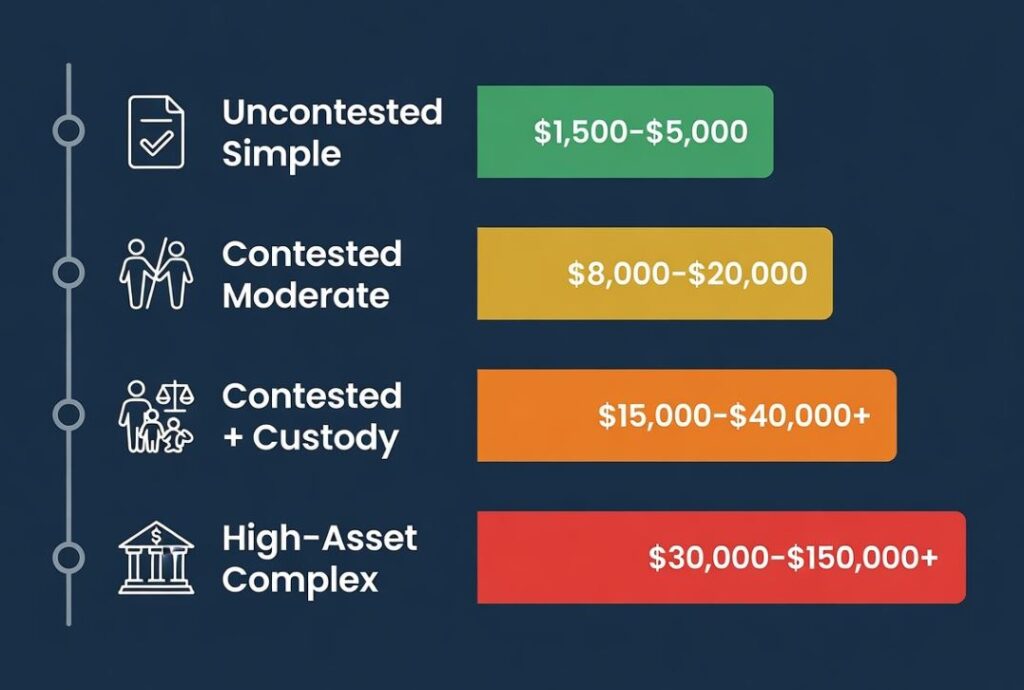
Uncontested divorce, minimal issues: $1,500–$5,000. One attorney or one mediator plus two reviewing attorneys. Short timeline, minimal back-and-forth.
Contested divorce, moderate complexity (some asset disputes, no children or agreed parenting plan): $8,000–$20,000 per spouse. Several months of negotiation, possible one or two hearings.
Contested divorce with custody dispute: $15,000–$40,000+ per spouse. The custody component alone can double or triple the cost of the property division component.
High-asset contested divorce with business interests: $30,000–$150,000+ per spouse. Business valuation, forensic accounting, extensive discovery, and trial preparation drive costs into a range that surprises most clients who haven’t been through it before.
Do-it-yourself divorce (no attorney): $200–$500 in court filing fees and forms. Only appropriate when the divorce is truly uncontested, the financial situation is simple, there are no minor children, and both parties fully understand what they’re agreeing to.
What’s Included in Attorney Fees (And What’s Not)
Attorney fees cover the attorney’s and staff’s time. They don’t cover court costs and other case expenses, which are billed separately:
- Court filing fees: $100–$400+ depending on state and county
- Process server fees: $50–$150
- Expert witness fees: Forensic accountants, custody evaluators, appraisers — each charged independently
- Deposition transcript costs if depositions are taken
- Mediation fees if required by the court or agreed to voluntarily (mediator fees typically run $150–$400 per hour, split between the parties)
How to Control Your Divorce Legal Costs
Choose the right level of representation for your situation. An attorney charging $400/hour is appropriate for a high-asset contested divorce. That same attorney handling an uncontested divorce with one rental property is using a more expensive resource than the situation requires.
Be organized. Attorneys bill for the time they spend on your case, including the time spent organizing information you provided disorganized. Bringing financial records sorted and labeled, responding to requests promptly, and keeping communications focused directly reduces the hours billed.
Use mediation before litigation. A mediator at $200–$300/hour for both parties combined is significantly cheaper than two attorneys litigating at $300/hour each. Courts in many states now require mediation before contested divorce hearings for precisely this reason.
Understand what decisions you control. Every contested issue you and your spouse can resolve by agreement reduces attorney time. The less you’re asking attorneys to fight over, the less they bill. This is worth remembering before escalating a dispute: is the cost of litigating this issue worth more than what’s being fought over?
Ask about fee estimates in advance. As the American Bar Association’s guidance on legal fees notes, at your first meeting the lawyer should estimate how much the total case will cost. Hold attorneys to this — ask for a realistic estimate range and what would push the case toward the higher end of that range.
When Cost-Shifting Helps
In some divorces, the court can order one spouse to pay a portion of the other’s attorney fees — typically when there’s a significant income disparity or when one spouse’s conduct has unnecessarily driven up costs. This doesn’t eliminate the need to fund your own representation during the case (fee awards usually come at the end), but it can affect the final net cost.
For a thorough explanation of when courts order one spouse to pay the other’s attorney fees and how that determination works, who pays attorney fees in a divorce covers the fee-shifting analysis in detail.
Understanding how long the process takes is also directly relevant to cost — a divorce that resolves in four months costs significantly less in attorney time than one that runs eighteen months. For realistic timeline expectations by case type, how long does the divorce process take provides the timeline context that directly affects budget planning.
FAQ
Why do I have to pay a retainer before the attorney does any work? The retainer system protects attorneys from clients who don’t pay — and protects clients from running up a bill they can’t pay. The retainer goes into a trust account and is drawn down as work is performed. Any unused retainer is returned at the end of the case.
What happens if I run out of retainer mid-case? Your attorney will notify you that the retainer is depleted and request a replenishment. Most fee agreements specify this process. Failure to replenish typically allows the attorney to withdraw from the case, subject to court approval.
Can I negotiate the hourly rate? Sometimes. Attorneys set their own rates, and some have flexibility — particularly for clients with strong cases or long anticipated relationships. Rates are more negotiable at smaller firms than at established family law firms with consistent demand. It doesn’t hurt to ask.
Is an expensive attorney always better? No. Higher hourly rates don’t automatically mean better representation. An experienced attorney who knows the local court, knows how opposing counsel typically operates, and can efficiently navigate the case may produce a better outcome than a higher-priced attorney who is less familiar with the jurisdiction. Look at track record and local reputation, not just rate.
Should I use the same attorney as my spouse to save money? No. An attorney cannot represent both spouses in a contested divorce due to the conflict of interest. Even in an uncontested divorce, having the same attorney represent both parties is ethically problematic in most jurisdictions — one attorney can represent one party, and the other spouse can hire a reviewing attorney or proceed without representation.
Are online divorce services a good alternative? For truly uncontested divorces with simple financial situations and no minor children, online document preparation services can handle the paperwork at significantly lower cost than an attorney. The risk is that you may not fully understand what you’re agreeing to — particularly around property division, tax implications, and waived rights. Having an attorney review a settlement agreement produced through an online service is a middle-ground approach that provides some protection at lower cost than full representation.
What if I can’t afford a divorce attorney at all? Legal aid organizations provide free family law assistance to income-eligible clients. Many bar associations run reduced-fee referral programs. Some attorneys offer payment plans. Self-representation (pro se) is an option for simple uncontested divorces, though the court paperwork requirements vary significantly by state and jurisdiction.
Conclusion
Divorce attorney costs range from a few thousand dollars for an uncontested matter handled efficiently to six figures for complex contested litigation involving businesses, substantial assets, and custody disputes. The single largest cost driver is how many issues remain in dispute when you walk through the attorney’s door — every agreement reached before hiring attorneys reduces the total bill. Understanding the fee structure (hourly vs. flat fee), asking for a realistic cost estimate before committing to representation, and actively managing your case to minimize unnecessary attorney time are the practical levers that give clients some control over a process that can otherwise feel financially uncontrollable.
Disclaimer: The content provided on MyLegalHelper.us is for informational and educational purposes only and does not constitute legal advice. Using this site does not create an attorney-client relationship. Always consult a licensed attorney in your specific jurisdiction before taking legal action.