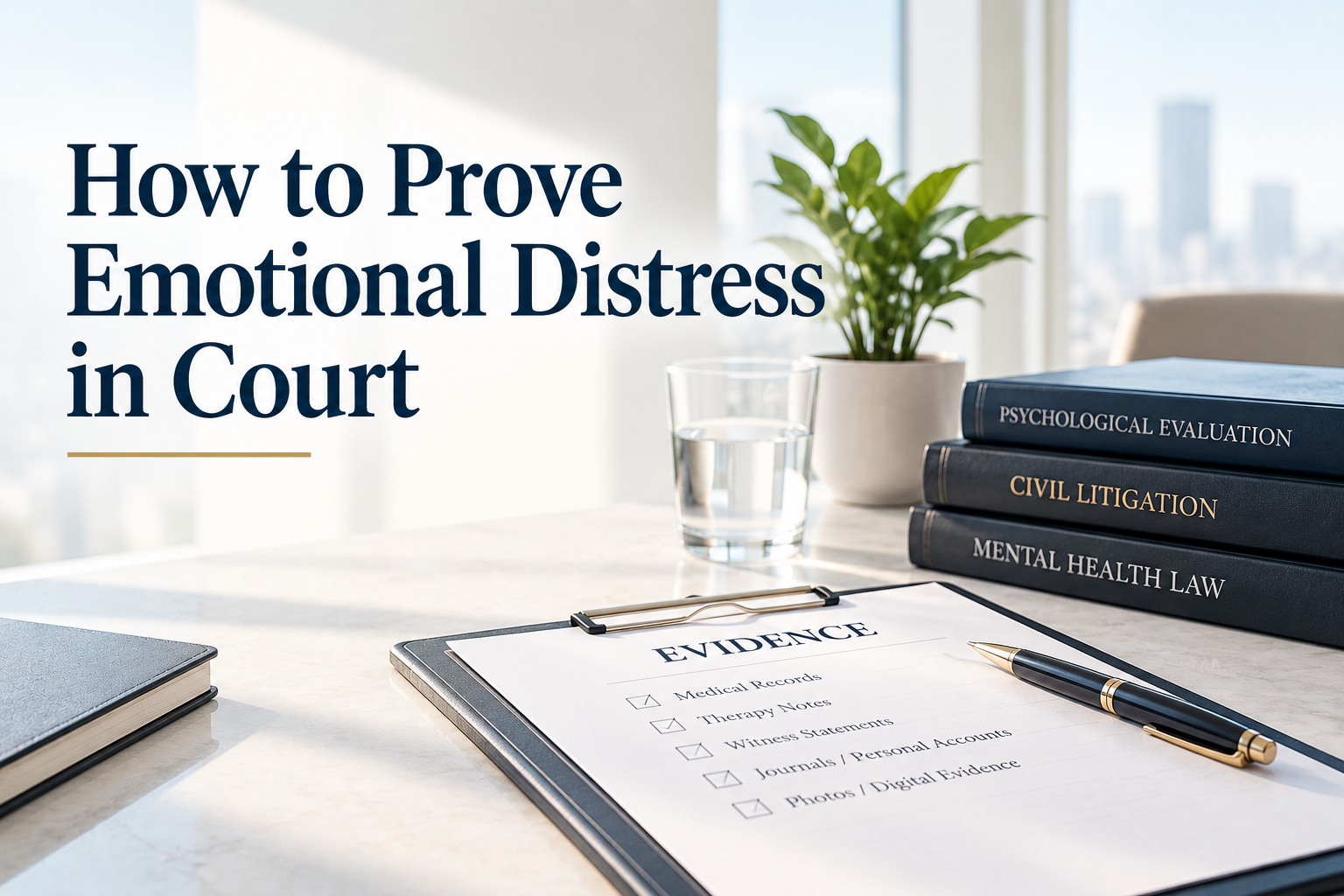
This article covers how a plaintiff proves emotional distress as part of a civil claim, meaning the actual evidence and legal elements courts look for, whether the claim arises from a car accident, a workplace dispute, a landlord conflict, or another civil matter. It does not cover criminal cases or claims where physical injury is the primary basis for damages. Unlike a broken bone or a medical scan, emotional distress has no single objective test, which is exactly why courts rely on a specific combination of evidence rather than any one document alone.
Key Takeaways
- Courts generally require proof of four elements: the defendant’s conduct, causation, severity, and duration, and no single piece of evidence typically satisfies all four on its own.
- Medical and mental health records carry the most weight of any evidence category, since they provide the closest thing to objective documentation that emotional distress claims have available.
- A claim built on multiple, independent evidence types together (medical records, personal documentation, witness testimony, and where applicable, physical symptoms or expert testimony) is substantially stronger than one relying on any single source.
What Courts Actually Require You to Show
Regardless of the specific legal theory, most emotional distress claims require proof of the same underlying elements. The defendant’s conduct must be established, meaning the other party acted negligently or, in more serious cases, intentionally and outrageously. Causation must connect that conduct directly to the emotional suffering, not just to the underlying incident generally. Severity requires showing the distress went beyond ordinary, temporary upset, something a reasonable person wouldn’t simply shake off. Duration matters too, since persistent, recurring distress over time is generally weighted more heavily than a brief, passing reaction.
Direct Answer: To prove emotional distress in court, you generally need documented evidence connecting a specific event or pattern of conduct to real, sustained psychological harm. Medical records and mental health treatment history carry the most weight, but courts also consider personal documentation, witness testimony, physical symptoms, and expert testimony together as a combined picture, since no single piece of evidence is typically considered sufficient on its own.
The Evidence That Actually Moves a Case Forward
Based on how courts across multiple jurisdictions consistently evaluate these claims, several categories of evidence come up repeatedly:
- Medical and mental health records. Documentation from a therapist, psychologist, psychiatrist, or counselor, including diagnosis, treatment plans, and session history, functions as the closest thing to objective proof available in these cases.
- Prescription and medication records. A documented history of medication prescribed specifically to manage anxiety, depression, or related symptoms adds another layer of professional corroboration beyond therapy records alone.
- Physical symptoms tied to the distress. Courts are often more receptive to claims that include documented physical manifestations, such as significant weight change, chronic headaches, ulcers, or sleep disruption, since these provide a form of corroborating evidence that pure emotional testimony doesn’t offer on its own.
- Personal journals and contemporaneous records. A journal or personal log kept during the period of distress, documenting specific symptoms, incidents, and their impact on daily functioning, offers a subjective but genuinely valuable perspective, particularly when the entries were made close in time to the events described rather than reconstructed after the fact.
- Witness testimony. Statements from family, friends, or coworkers who observed changes in mood, behavior, or daily functioning can meaningfully corroborate a claim, especially when multiple independent witnesses describe consistent changes.
- Employment records. Missed workdays, documented performance decline, demotion, or job loss connected to the distress can help establish both severity and real-world impact.
- Expert testimony. A licensed mental health professional testifying specifically about the nature, severity, and likely cause of the plaintiff’s symptoms carries particular weight, since it translates personal experience into a professional clinical assessment the court can evaluate.
| Evidence Type | What It Establishes |
|---|---|
| Medical/therapy records | Diagnosis, treatment history, professional corroboration |
| Physical symptoms | Corroborating evidence beyond subjective testimony |
| Personal journal entries | Contemporaneous documentation of severity and daily impact |
| Witness testimony | Independent observation of behavioral or mood changes |
| Employment records | Real-world impact on functioning and productivity |
| Expert testimony | Professional clinical assessment of cause and severity |
[COMMON TRAP] Don’t assume a single strong piece of evidence, like one therapy session or one supportive witness statement, is enough on its own. Courts consistently look for a combined picture across several evidence categories. A claim resting entirely on personal testimony without any medical documentation, physical symptoms, or independent corroboration is considerably more vulnerable to being minimized or dismissed, even if the underlying distress is genuine.
Why Severity and Duration Matter as Much as the Evidence Itself
Beyond simply gathering documentation, courts weigh how intense and how long-lasting the distress actually was. A brief period of stress following an isolated incident is treated very differently than persistent, recurring symptoms, such as ongoing PTSD, that continue affecting daily life months or years later. The more the underlying incident itself was extreme, courts also tend to find it more plausible that severe emotional distress resulted, which is part of why the specific facts of the triggering event matter alongside the evidence documenting the aftermath.
[PRO TIP] Start documentation as early as possible after the distress begins, rather than waiting until you’ve decided to pursue a claim. A journal entry written the same week symptoms began carries more credibility than one reconstructed months later from memory, and an early therapy appointment establishes a documented timeline that’s difficult to challenge as an afterthought designed to support litigation.
How This Plays Out Depending on the Type of Claim
The general evidence framework applies across different claim types, but the specific conduct being proven varies. In a workplace emotional distress claim, evidence often centers on documented harassment, discrimination, or retaliation alongside employment records showing productivity or attendance impact. In a landlord-tenant context, evidence typically focuses on documented illegal entry, harassment, or a hazardous condition left unaddressed despite repeated notice. In a personal injury context, the underlying accident or incident itself often serves as the starting point, with medical and psychological documentation establishing the emotional harm that followed.
Frequently Asked Questions
Do I need a mental health diagnosis to prove emotional distress? Not always, but a formal diagnosis from a licensed provider significantly strengthens a claim. Courts generally weigh professional medical documentation far more heavily than personal testimony alone, even when the underlying distress is genuine.
Can I still win a claim without physical symptoms? Yes, physical symptoms aren’t required, but their presence, such as documented weight loss, chronic headaches, or sleep disruption, often makes a claim more persuasive by providing corroborating evidence beyond subjective emotional testimony.
How important is witness testimony compared to medical records? Medical records generally carry more weight as a category, but witness testimony plays a meaningful corroborating role, particularly when multiple independent witnesses describe consistent behavioral or mood changes over time.
Is a personal journal considered reliable evidence in court? It’s considered valuable, though inherently subjective, evidence. Its credibility increases significantly when entries were made close in time to the events described, rather than written or reconstructed well after the fact specifically for litigation purposes.
What’s the difference between negligent and intentional infliction of emotional distress for evidence purposes? The evidence categories are largely similar, but intentional infliction (IIED) generally requires additionally proving the defendant’s conduct was extreme and outrageous, done intentionally or recklessly, which often requires more detailed documentation of the specific conduct itself, not just its emotional aftermath.
Do I need an attorney to prove emotional distress in court? It isn’t strictly required for every case, but claims involving expert testimony, contested severity, or significant damages generally benefit substantially from legal representation, since building a combined evidentiary picture across multiple categories is considerably more effective with experienced guidance.
Conclusion
Proving emotional distress in court comes down to building a combined, credible picture across several types of evidence rather than relying on any single document or statement. Medical and mental health records carry the most weight, but personal documentation, physical symptoms, witness testimony, and expert opinion all play a real, corroborating role. Starting to document symptoms and their impact as early as possible, rather than reconstructing a timeline later, consistently strengthens how credible a claim appears to a court.
This evidence framework applies whether the underlying claim involves suing a landlord for emotional distress or suing an employer for emotional distress, both of which are worth reviewing for how the general principles covered here apply to those specific situations.
Disclaimer: The content provided on MyLegalHelper.us is for informational and educational purposes only and does not constitute legal advice. Using this site does not create an attorney-client relationship. Always consult a licensed attorney in your specific jurisdiction before taking legal action.