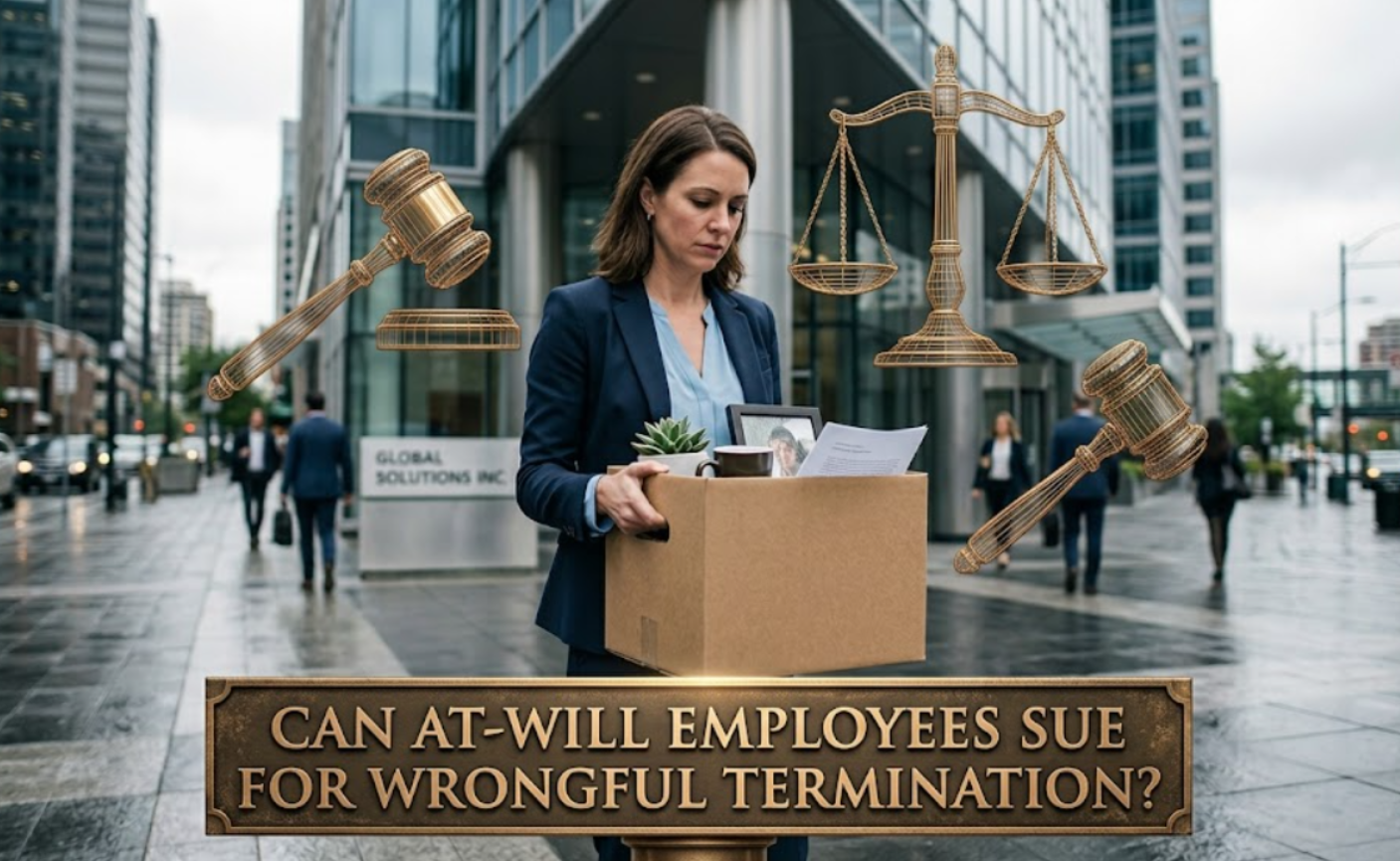
Yes, at-will employees can sue for wrongful termination, just not for the reason most people assume. At-will status means your employer doesn’t need a good reason to fire you. It doesn’t mean they can fire you for an illegal one. If your termination violated a specific law, broke a contract, or crossed a line courts recognize as against public policy, you may have a valid claim even though you were technically an at-will employee.
Can an at-will employee sue for wrongful termination?
At-will employees can sue for wrongful termination when the firing violates a specific legal protection, such as anti-discrimination law, whistleblower protections, an employment contract, or a recognized public policy exception. At-will status removes the need for “good cause,” not the requirement to follow the law.
That’s a narrower path than employees in “for cause” jobs have, but it’s a real one. Courts have carved out exceptions to at-will employment in every state, and federal law adds its own layer of protection on top. The challenge isn’t usually whether you can sue. It’s whether your specific situation fits inside one of the recognized exceptions, which is where most wrongful termination cases actually get won or lost.
What “at-will employment” actually means
At-will employment is the default rule in nearly every U.S. state: either side can end the working relationship at any time, for almost any reason, or no reason at all, without advance notice. Your employer doesn’t have to explain the firing, doesn’t have to give you a warning first, and doesn’t have to prove you did anything wrong.
Montana is the one notable exception. After a probationary period, Montana law requires employers to have “good cause” to fire an employee, a protection most other states reserve for union contracts or specific public-sector jobs.
At-will status confuses a lot of people because it sounds like employers can do whatever they want. It doesn’t. It means employers don’t need a reason. They still can’t fire you for an illegal one, and that distinction is the entire basis for a wrongful termination claim.
The legal exceptions that let at-will employees sue
Discrimination
Federal law bars employers from firing someone because of race, color, religion, sex, national origin, age (40 and older), disability, or genetic information. Many states add further protected categories, including sexual orientation, gender identity, marital status, and pregnancy. If your firing was motivated by your membership in one of these protected classes, at-will status won’t shield your employer.
Retaliation
Employers can’t fire you for engaging in legally protected activity. That includes filing a discrimination complaint, reporting harassment, requesting a workplace accommodation, filing a workers’ compensation claim, or blowing the whistle on illegal conduct. Retaliation claims often hinge on timing: a firing that follows closely after a complaint or report tends to draw scrutiny, even though timing alone rarely wins a case by itself.
Violation of public policy
Most states recognize a public policy exception, which protects employees fired for reasons that conflict with a clear, established public interest. Classic examples include firing someone for refusing to break the law, for serving on a jury, for voting, or for filing a workers’ compensation claim. The exact scope of this exception varies a lot by state, so what counts as a public policy violation in one state may not in another.
Breach of an implied contract
Even without a signed employment contract, some courts will find an implied agreement based on an employee handbook, verbal promises made during hiring (“you’ll always have a job here as long as you do good work”), or a long, consistent pattern of progressive discipline before firing. If your employer’s own policies promised a process, like written warnings before termination, and skipped it, you may have a contract-based claim.
Implied covenant of good faith and fair dealing
A smaller number of states recognize a related exception built on the idea that employment relationships carry an implicit duty of fair dealing. This exception is read narrowly almost everywhere it exists, and it’s usually argued alongside an implied contract claim rather than on its own.
| Exception | What it covers | Who enforces it |
|---|---|---|
| Discrimination | Firing based on race, sex, age, disability, religion, and other protected traits | EEOC and state fair employment agencies |
| Retaliation | Firing for reporting violations, filing complaints, or requesting accommodations | EEOC, OSHA, NLRB, or state labor agencies, depending on the activity |
| Public policy | Firing for refusing illegal acts, jury duty, voting, or similar protected conduct | State courts |
| Implied contract | Firing that breaks promises made in a handbook or during hiring | State courts |
| Good faith and fair dealing | Firing that breaches an implied duty of fair dealing, in a limited number of states | State courts |
What you need to prove to win a wrongful termination case
Winning isn’t just about showing you were fired. You generally need to connect the firing to one of the exceptions above and show that the reason your employer gave doesn’t hold up. That usually means demonstrating:
- You belong to a protected class, engaged in protected activity, or had a contract or policy your employer broke.
- Your employer took an adverse action, in this case the termination.
- There’s a connection between the two, often shown through timing, comments from supervisors, inconsistent explanations, or treatment that differs from how other employees were handled in similar situations.
Documentation carries a lot of weight here. Performance reviews, emails, text messages, and a timeline of events tend to matter more than memory alone once a case moves forward.
Steps to take if you think you were wrongfully terminated
- Write down what happened while it’s fresh: dates, names, what was said, and who else was present.
- Gather your records: performance reviews, the employee handbook, any contract you signed, and relevant emails or messages.
- Check the deadline that applies to your claim. Discrimination claims generally need to go to the EEOC within 180 days of the firing, or 300 days if your state has its own fair employment agency, which most do. Other claims may follow different state deadlines.
- File with the right agency first, if your claim requires it. Discrimination claims typically need an EEOC or state agency charge before you can sue. Other claims, like breach of contract, go straight to court.
- Talk to an employment attorney before signing anything. Severance agreements often include a release of claims, and once you sign, you may lose your right to sue.
Frequently asked questions
Can my employer fire me without giving a reason? Yes, in most states. At-will employment lets employers end the relationship without explanation, as long as the real reason isn’t illegal.
How long do I have to file a wrongful termination claim? It depends on the claim. Discrimination charges generally need to reach the EEOC within 180 to 300 days. Other claims follow state deadlines that can range from one to several years.
Do I need to file with the EEOC before I can sue for discrimination? Usually, yes. Federal discrimination claims require an EEOC charge first. The agency issues a “right to sue” letter once that step is complete.
What can I recover if I win a wrongful termination case? Common remedies include back pay, reinstatement or front pay, compensatory damages for emotional distress, and in some cases punitive damages or attorney’s fees.
Does at-will employment exist in every state? Nearly every state follows at-will employment by default. Montana is the main exception, requiring good cause for termination after a probationary period.
Can I sue if I never signed a written contract? Possibly. Some states recognize implied contracts based on handbooks or verbal promises, even without a signed agreement.
Is it wrongful termination if I was fired for poor performance? Not usually, unless the stated performance reason is a pretext for an illegal motive, like discrimination or retaliation, and the documentation doesn’t support it.
The bottom line
At-will employment gives employers a lot of room to let someone go, but it isn’t unlimited. If your firing involved discrimination, retaliation, a broken promise, or a violation of public policy, you may have grounds to sue regardless of your at-will status. The hardest part is usually figuring out which exception, if any, applies to your situation, which is where a consultation with an employment attorney tends to be worth the hour.
This article is for general information and isn’t legal advice. Employment laws vary by state and change over time, so talk to a licensed employment attorney about your specific situation before taking action.