
Texas divorces range from under $500 for a simple uncontested case handled without an attorney to well over $30,000 for contested matters involving children, property disputes, or custody battles. The range is wide because the cost drivers in a Texas divorce are predictable — and knowing them upfront helps you understand where your case falls and what you can do to influence the outcome.
Key Takeaways
- Court filing fees in Texas run $250–$400 depending on the county — Harris County charges $350 without children and $365 with children; Bexar County ranges from $250–$350
- Texas divorce attorneys charge $200–$500 per hour depending on location and experience, with a statewide average around $300/hour in 2026; most require a $2,500–$5,000 upfront retainer
- Texas imposes a mandatory 60-day waiting period from the date the petition is filed before any divorce can be finalized, regardless of how quickly both parties agree
The Mandatory 60-Day Waiting Period and What It Costs You
Before getting into numbers, one Texas-specific rule shapes every cost calculation: Texas Family Code § 6.702 requires a minimum 60-day waiting period from the date the Original Petition for Divorce is filed before the court can grant a final decree. The clock starts at filing, not at service on the other spouse, and weekends and holidays count.
The practical cost effect: an uncontested divorce where both spouses agree on everything still takes at least 61 days from filing to finalize. Attorney fees accrue during that waiting period. If your case settles quickly but requires follow-up emails, document preparation, and filing the final decree, those are billable hours during the wait. The 60-day period is not waivable except in family violence situations — courts will dismiss or pause cases that try to finalize before the 61st day.
The only exception: if your spouse was convicted of or received deferred adjudication for family violence against you or a household member, or if an active protective order is in place based on family violence during the marriage, the 60-day wait can be waived.
Court Filing Fees by County
Texas district clerk filing fees are set by the Texas Legislature within county-specific frameworks, which is why the fee varies across the state. For 2026, Harris County charges $350 for divorces without children and $365 with children. Bell County charges $350, and Bexar County ranges from $250–$350.
The filing fee is paid by the petitioner — the spouse who files first. The respondent (the spouse served with the petition) pays a separate answer fee if they formally respond to the petition, typically $100–$200 depending on the county.
Additional mandatory fees that appear at or after filing:
- Process server or constable fee: $75–$200 to formally serve the petition on the other spouse
- Certified copy fees: $1–$2 per page for certified copies of the final decree you’ll need for name changes, property transfers, and financial account updates
- E-filing fee: Most Texas counties require electronic filing, which carries a statewide e-filing fee of approximately $5–$10 per document
Fee waiver eligibility: Texas law permits fee waivers for individuals who cannot afford court costs under Texas Rule of Civil Procedure 145. Eligibility includes receiving government benefits such as TANF, SNAP, or Medicaid, earning below 125% of the federal poverty level, or demonstrating genuine financial hardship. You must file a Statement of Inability to Afford Payment of Court Costs with your petition.
Attorney Fees: The Largest Variable
Texas divorce attorneys charge between $200 and $500 per hour, with the statewide average hovering around $267–$300 per hour in 2025–2026. Location significantly impacts rates: Houston attorneys average $300 per hour, Dallas attorneys charge $200–$500 per hour, and Fort Worth attorneys range from $175–$325 per hour.
Retainers — the upfront deposit drawn against as the attorney bills — typically cost $2,500–$5,000 before beginning work. The retainer is not the total cost; it’s the starting deposit. When it’s depleted, you replenish it or the attorney stops working on the case.
Hours by case type:
An uncontested divorce where both parties have already agreed on all terms may require only 8–15 hours of attorney time — drafting the agreed decree, reviewing it, filing it, and handling any court appearance. At $300/hour, that’s $2,400–$4,500 in attorney fees on top of filing costs.
A contested divorce involving property division, spousal support negotiations, or moderate disagreements typically requires 30–80 hours. At $300/hour, that’s $9,000–$24,000 per spouse.
A contested divorce involving children — custody disputes, child support calculations, temporary orders hearings — escalates further. The average Texas divorce costs $15,000–$30,000 with children and $10,000–$20,000 without children, according to 2025–2026 attorney surveys. Temporary orders hearings alone, which address immediate custody arrangements and exclusive use of the marital home while the divorce proceeds, can cost $5,000–$7,500 just for the initial phase.
Texas Community Property Rules and Their Cost Impact
Texas is a community property state. Under Texas Family Code § 3.002, all property acquired during the marriage is presumed to be community property and subject to division. Courts divide community property in a manner deemed “just and right” (Texas Family Code § 7.001), which does not necessarily mean 50/50 — factors like fault in the breakup and earning capacity influence the division.
Community property disputes drive up costs through:
Business valuations: If either spouse owns or co-owns a business, a forensic accountant or business valuation expert is required. A couple with a business, multiple properties, stock options, or significant debt requires forensic accountants ($5,000–$15,000) and business valuators ($3,000–$10,000).
Retirement account division: Dividing 401(k)s, pensions, and IRAs requires a Qualified Domestic Relations Order (QDRO), a separate legal document that typically costs $500–$1,500 per retirement account in addition to attorney fees.
Real property: If you own a home, disputes over its value, equity, or who keeps it require an appraisal ($400–$600) and potentially a real estate expert.
Mediation Costs
While Texas statutes do not universally mandate mediation, many counties and specific district courts require it before allowing trials. Even where not required, mediation is strongly encouraged and frequently resolves disputes at lower cost than litigation.
A trained mediator typically charges $200–$400 per hour, and most divorces settle in 1–3 full-day sessions, bringing mediation costs to $3,000–$7,000. This cost is typically split between the spouses. While it sounds expensive, a single day of mediation at $3,500 total is significantly cheaper than a contested hearing with two attorneys billing $300/hour each.
When parties reach agreement through mediation and execute a Mediated Settlement Agreement (MSA) under Texas Family Code § 6.602, that agreement is binding and irrevocable — it cannot be set aside except in very limited circumstances. This finality is both the strength of mediation (it resolves the case) and a reason to review any MSA carefully with your attorney before signing.
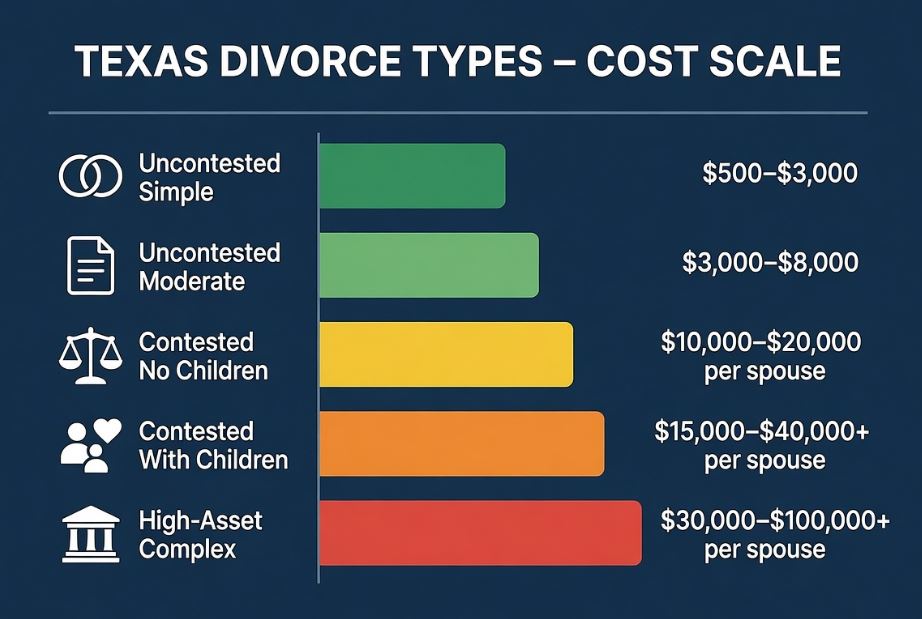
Realistic Total Cost Ranges for Texas Divorces
Uncontested, no children, no significant property: $500–$3,000 total. Filing fee plus attorney time to draft and file the agreed decree. Some couples use online divorce document services for even less, though attorney review is advisable before signing any final decree.
Uncontested, moderate complexity (house, retirement accounts, no children): $3,000–$8,000. Attorney time for property division agreement, QDRO preparation, real estate documents.
Contested, no children: $10,000–$20,000 per spouse. Negotiation, discovery, possible mediation, and hearing preparation.
Contested with children (custody dispute): $15,000–$40,000+ per spouse. Temporary orders hearings, custody evaluations, child support calculations, and potential trial preparation.
High-asset contested (business interests, significant property): $30,000–$100,000+ per spouse. Business valuations, forensic accounting, extensive discovery, and trial.
Fee-Shifting: When Your Spouse Pays Your Attorney Fees
Under Texas Family Code § 6.708, courts may order one spouse to pay the other’s reasonable attorney fees and costs. This fee-shifting provision aims to level the playing field when one spouse controls significantly more marital assets or income, ensuring both parties can afford quality representation.
Fee awards in Texas divorce are at the court’s discretion and depend on the relative financial positions of the spouses, the conduct of the parties during litigation, and whether either party engaged in delay tactics or bad-faith behavior that increased the other’s costs. Fee awards are more common when one spouse has significantly more access to marital funds during the case.
Courts can also sanction attorneys or parties for abusive litigation conduct under Texas Rule of Civil Procedure 13, which can include ordering the offending party to pay the opposing side’s fees attributable to the misconduct.
Texas Residency Requirements Before You Can File
Before filing costs any money, confirm you meet the residency requirement: Texas requires at least one spouse to have lived in the state for a minimum of 6 continuous months and in the filing county for at least 90 days before submitting a divorce petition under Texas Family Code § 6.301.
Filing before meeting residency requirements results in case abatement (temporary hold) rather than dismissal. Courts pause proceedings until the filing spouse satisfies the 6-month/90-day threshold, then resume. However, proceeding prematurely wastes filing fees and delays resolution.
How to Reduce Your Texas Divorce Costs
Agree on as much as possible before retaining an attorney. Every issue resolved before you hire an attorney reduces billable hours. Even informal discussions about who keeps the house, how retirement accounts split, and custody arrangements — if both parties are willing — can save thousands.
Organize financial documents before your first attorney meeting. Attorney time spent gathering bank statements, tax returns, retirement account statements, and property deeds is billable time you could save by having these ready before your first meeting.
Use mediation proactively, not as a last resort. Many couples wait until the court orders mediation — after months of litigation have already run up costs. Scheduling mediation early, before positions harden, produces settlements at a fraction of the cost.
Consider a limited scope (unbundled) representation arrangement. Some Texas attorneys handle specific tasks — reviewing a mediated settlement, preparing a QDRO, advising on a single hearing — rather than full representation. This reduces total cost while ensuring professional review of documents you don’t fully understand.
For a broader understanding of how attorney fee structures work across different types of legal matters — including the retainer system and what you’re actually paying for — how much are lawyer and attorney fees provides context that applies directly to retaining a Texas divorce attorney.
For realistic expectations about the timeline from filing to finalization — which directly affects how long attorney fees accrue — how long does the divorce process take covers what drives the duration of divorce cases at each level of complexity.
FAQ
Can I get a divorce in Texas without an attorney? Yes. Pro se (self-represented) divorce is legal in Texas. The Texas courts’ self-help website (selfhelp.efiletexas.gov) provides standard forms. Uncontested divorces with no children and simple finances are the most manageable pro se. Complex property situations, contested custody, and business interests are significantly harder without representation and carry real risk of unfavorable outcomes from procedural errors.
What is the cheapest way to get a divorce in Texas? An uncontested divorce where both parties agree on all terms and handle the paperwork through online legal document services costs as little as $300–$500 in filing fees only. Adding attorney review of the final decree before signing (typically $500–$1,500) is advisable even for the simplest cases.
Does Texas require separation before divorce? No. Texas does not require a separation period before filing. The 60-day waiting period begins at filing — you can file the day after deciding to divorce. You do not need to be living separately, and Texas does not recognize legal separation as a formal status.
Can my spouse and I use the same attorney? No. An attorney cannot ethically represent both spouses in a divorce, as their interests are inherently adverse. In an uncontested divorce, one attorney typically represents the petitioner; the other spouse reviews and signs documents without legal representation (or hires a separate attorney for review only).
Does fault affect the cost of a Texas divorce? Potentially. Texas recognizes seven grounds for divorce under Texas Family Code §§ 6.001–6.007, divided into one primary no-fault ground and six fault-based grounds. The vast majority of Texas divorces cite insupportability, the no-fault option, because it requires no proof of wrongdoing and streamlines the process. Pursuing fault grounds (adultery, cruelty, abandonment) requires evidence, which means discovery, witnesses, and additional attorney time — all of which increase cost. Fault findings can influence property division in some cases, but whether that outcome justifies the additional litigation cost depends on the specific facts.
What happens after the decree is signed? After the 61st day and once the judge signs the final decree, there is a 30-day waiting period before remarriage under Texas Family Code § 6.801. You then need certified copies of the decree for name change procedures, financial account updates, property transfer filings, and QDRO processing. These administrative steps carry their own small fees but are routine.
Conclusion
The cost of a Texas divorce is determined primarily by how much the parties agree on before and during the process. Filing fees are fixed and manageable — $250–$400 depending on county. Attorney fees are the variable that drives the total cost from $3,000 to $30,000+, and those fees accumulate directly with the level of dispute. Texas’s mandatory 60-day waiting period and community property rules create specific cost pressures that don’t exist in all states — knowing both going in helps you plan realistically and make decisions about where to invest in legal help versus where to reach agreement independently.
Disclaimer: The content provided on MyLegalHelper.us is for informational and educational purposes only and does not constitute legal advice. Using this site does not create an attorney-client relationship. Always consult a licensed attorney in your specific jurisdiction before taking legal action.