
The cost of suing someone ranges from under $100 to hundreds of thousands of dollars depending on where you file, whether you hire an attorney, and how far the case goes before it resolves. Those numbers aren’t arbitrary — they reflect predictable cost categories that apply to almost every lawsuit. Understanding them upfront helps you decide whether a lawsuit makes financial sense before you commit to one.
Key Takeaways
- Court filing fees alone run from $30–$100 in small claims court to $405 in federal district court — these are unavoidable costs that don’t include any attorney
- Attorney fees represent the largest variable cost and are typically charged hourly ($200–$500/hour depending on case type and location) or on contingency for certain case types like personal injury
- The total cost of pursuing a lawsuit through trial regularly exceeds the value of what’s being disputed in smaller cases — which is why most cases settle and why small claims court exists for disputes under a certain dollar threshold
The Cost Categories in Any Lawsuit
Every lawsuit involves some combination of the same cost categories. Which categories apply and how much each costs depends entirely on your specific situation.
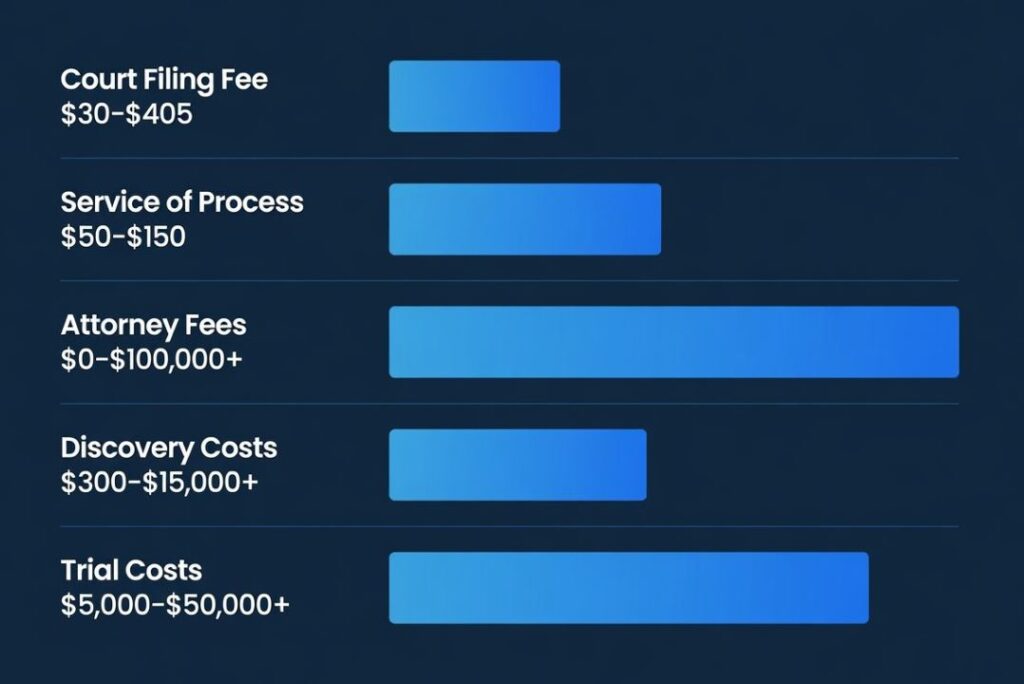
1. Court Filing Fees
These are non-negotiable — you pay them when you file, regardless of whether you win. They vary by court level and jurisdiction.
Small claims court: $30–$100 in most states. Some states cap fees lower; a few charge slightly more. Small claims is designed to be accessible without an attorney, which is reflected in the low filing fees.
State civil court (general jurisdiction): $200–$400 is typical for filing a civil complaint in most state courts, though this varies significantly. California Superior Court fees are on the higher end; some rural county courts charge less.
Federal district court: $405 for filing a civil complaint, as established in the U.S. District Court Fee Schedule. This fee applies regardless of the size of the claim.
Fee waivers: Plaintiffs who qualify financially can apply for in forma pauperis status, which waives filing fees in federal court and most state courts. The threshold for qualification varies by court.
2. Service of Process Fees
After filing, you have to formally serve the defendant with the lawsuit. This typically costs $50–$150 per defendant if you use a professional process server. In some jurisdictions, the sheriff’s office handles service for a similar fee. Some courts allow service by certified mail at lower cost.
If you’re suing multiple defendants, you pay service costs per defendant.
3. Attorney Fees
This is where costs become highly variable.
No attorney (pro se): You pay only court costs. Small claims cases are specifically designed for self-representation, and many people handle them without any legal help. State civil court cases can theoretically be handled pro se as well, though complexity increases significantly.
Hourly billing: The most common fee structure for civil litigation. Attorneys charge $150–$600+ per hour depending on the practice area, their experience, and the geographic market. A relatively simple breach of contract case handled by a mid-market attorney might take 20–40 hours to settle, totaling $4,000–$12,000. A case that goes to trial can take 100–300+ hours, totaling $20,000–$100,000 or more.
Contingency fees: Available for certain case types — primarily personal injury, workers’ compensation, and some employment and consumer protection claims. The attorney takes 33–40% of any recovery; if you lose, the attorney receives no fee. Case costs are typically still owed regardless of outcome.
Flat fees: Some attorneys handle straightforward cases — demand letters, simple collections, uncontested matters — for a fixed fee. These are more common for predictable, contained scopes of work than for full litigation.
4. Discovery Costs
If your case reaches the discovery phase — the pre-trial period when parties exchange information and evidence — additional costs accumulate:
Deposition transcripts: $300–$600 per deposition for a court reporter and transcript. Complex cases may involve dozens of depositions.
Document production: Copying, scanning, and organizing documents for production. For large document volumes, this can run into the thousands.
Expert witnesses: If your case requires expert testimony (medical experts, forensic accountants, accident reconstruction specialists), expert fees run $3,000–$15,000+ depending on the expert’s field and how much time they spend on the case.
Subpoena costs: Issuing subpoenas to third parties for documents or testimony carries court fees and sometimes requires a process server.
5. Trial Costs
Relatively few civil lawsuits actually reach trial — most settle somewhere between filing and trial. But if yours does go to trial:
Jury fees: Some courts charge daily jury fees to the party requesting a jury trial, typically $150–$400 per day.
Trial preparation costs: Demonstrative exhibits, trial technology, witness preparation — these add up quickly in complex cases.
Attorney time at trial: Trial days are the most expensive attorney billing — preparation, court time, and follow-up can easily run 12–15 hours per day of actual trial.
Cost by Case Type
The type of dispute significantly affects expected total cost because it determines fee structures, required expertise, and typical duration.
Personal injury: Usually contingency, meaning no upfront attorney costs. Case costs (medical records, expert witnesses) are advanced by the attorney and reimbursed from any settlement. Low financial risk to plaintiff upfront; high cost relative to recovery if the case is weak.
Breach of contract: Typically hourly billing. Small contract disputes ($5,000–$15,000) often cost more in attorney fees than the underlying dispute is worth — which is why small claims or demand letters are more practical for small amounts.
Landlord-tenant disputes: Small amounts typically handled in small claims court at low cost. Larger habitability claims or wrongful eviction actions involve more attorney time.
Employment discrimination: Federal cases involve EEOC process first (free), then litigation. Many employment attorneys work on contingency for discrimination and retaliation claims because federal fee-shifting statutes (Title VII, ADA, ADEA) require losing employers to pay prevailing plaintiffs’ attorney fees.
Debt collection: Filing fees plus service costs plus attorney time. For small amounts, a debt collector’s economics rarely justify litigation — which is why many small collection cases go through a demand letter or small claims process rather than full civil litigation.
Business disputes: Highly variable. Straightforward contract disputes might cost $10,000–$30,000 to litigate through settlement. Complex partnership disputes or business torts can run $100,000–$500,000+.
The Economics of Suing: When It Makes Financial Sense
The total cost of litigation is only one side of the calculation. The other side is what you stand to recover — and what’s the realistic probability of actually collecting if you win.
The cost-benefit analysis: A $15,000 breach of contract claim that costs $20,000 in attorney fees to litigate through trial is a losing proposition regardless of whether you win. The same claim handled through small claims court for $75 in filing fees is economically rational.
Collectability matters as much as winning: A judgment is a piece of paper saying someone owes you money. Collecting on it requires additional steps — wage garnishment, bank account levies, property liens — and if the defendant has no assets or income to collect, the judgment is effectively worthless. Winning a lawsuit against someone with no money to pay produces nothing except a judgment you can’t enforce.
Settlement economics: Most cases settle before trial because both sides assess the costs of continuing litigation against the likelihood of a better outcome. A defendant who owes $50,000 might settle for $35,000 to avoid $20,000 in additional attorney fees and trial risk. A plaintiff might accept $35,000 to avoid another year of litigation and the possibility of losing.
Understanding how long the litigation process actually takes is directly relevant to the cost calculation — a case that runs 18 months accumulates significantly more in attorney fees than one that settles in 4 months. For a realistic sense of timeline by case type, how long does a lawsuit take covers what drives the duration of civil litigation.
Small Claims Court: When It’s the Right Answer
Small claims court exists specifically to provide a low-cost path for smaller disputes. It’s worth knowing the key characteristics:
Limits: Most states cap small claims at $5,000–$12,500. California allows up to $12,500 for individuals; some states are lower. Claims above the limit must go to regular civil court.
Attorneys: Most small claims courts don’t allow attorney representation during the hearing itself, though you can consult an attorney beforehand.
Procedure: Significantly simplified compared to civil court. No formal discovery, no depositions, often no formal rules of evidence. You present your case directly to a judge.
Cost: Filing fees of $30–$100. Your time to prepare and appear. That’s essentially the full cost.
Best for: Unpaid invoices, security deposit disputes, minor property damage, small contract breaches, landlord-tenant disputes within the dollar limit.
For a deeper look at the process, the small claims eligibility checker can help you assess whether your dispute fits the small claims framework before you decide which court to file in.
Recovering Your Legal Costs From the Defendant
In most American civil litigation, each side pays its own attorney fees regardless of outcome — this is called the “American Rule.” The losing party doesn’t automatically owe the winner’s legal costs.
Exceptions where fee-shifting is possible:
Contract with fee-shifting clause: If your contract includes a provision that the losing party pays attorney fees in any dispute, courts generally enforce it.
Federal fee-shifting statutes: Certain federal laws — employment discrimination, civil rights, consumer protection, copyright — explicitly allow or require the losing defendant to pay the prevailing plaintiff’s attorney fees.
Frivolous litigation sanctions: Courts can sanction attorneys or parties for filing frivolous claims or defenses, sometimes including fee awards.
State-specific fee-shifting: Some states have statutes that allow fee recovery in specific types of cases — consumer protection claims, insurance bad faith actions, and others.
Even when fee-shifting applies, courts typically award “reasonable” fees — not necessarily what you actually paid. The court determines what’s reasonable based on market rates and the work performed.
For broader context on how attorney fees are structured across different types of cases, how much are lawyer and attorney fees covers the full fee structure landscape including hourly, contingency, and flat fee arrangements.
FAQ
Can I sue without a lawyer to save money? Yes. Pro se litigation — representing yourself — is legal in every court. Small claims court is designed for it. State and federal civil court allow it but are significantly more complex, with procedural rules that disadvantage people who don’t know them. Many pro se litigants in civil court lose winnable cases due to procedural errors, not the merits of their claims.
What if I can’t afford the filing fee? Apply for in forma pauperis (IFP) status, which waives filing fees for financially eligible plaintiffs. Most courts have a standard form for this application. The threshold varies by court, but it generally requires demonstrating that paying the fee would create a financial hardship.
Are there situations where suing is essentially free? Contingency fee cases with strong facts are as close as it gets — no upfront attorney costs, filing fees waived if IFP qualifies, and costs advanced by the attorney. For personal injury, employment discrimination, and some consumer protection cases, this structure is genuinely available.
What does it cost to send a demand letter before suing? A demand letter from an attorney — which is often more effective than one from the aggrieved party directly — typically costs $300–$800 depending on the complexity of the underlying claim. Many disputes resolve after a demand letter, making it the most cost-effective first step before filing.
If I win, do I get my filing fees back? Often yes — court costs (including filing fees and service of process) are typically awarded to the prevailing party as a matter of course. Attorney fees are a separate question governed by the American Rule and its exceptions.
How much does it cost to appeal a judgment I lost? Appeals involve separate filing fees ($200–$500+ depending on the court), attorney time to research and write appellate briefs (typically 20–60+ hours), and the appellate court’s briefing schedule. Appeals are expensive and rarely reverse trial court decisions — the standard of review is deferential to trial courts on factual questions.
Conclusion
The cost of suing someone depends on which court you use, whether you need an attorney, what the case involves, and how long it takes to resolve. Small claims court keeps costs in the $30–$200 range for disputes that fit within the dollar limits. State and federal civil court suits with attorneys routinely run $10,000–$50,000 for cases that settle and multiples of that for cases that go to trial. The fundamental economic question — whether the cost of litigation is proportionate to what you stand to recover and actually collect — should be the first calculation, not an afterthought.
Disclaimer: The content provided on MyLegalHelper.us is for informational and educational purposes only and does not constitute legal advice. Using this site does not create an attorney-client relationship. Always consult a licensed attorney in your specific jurisdiction before taking legal action.